Class 10 is the first point where your choices start to shape your career. The decision is not permanent — people change direction later — but a sensible choice now saves time. This guide sets out the main options, who each one suits, and what to do next.
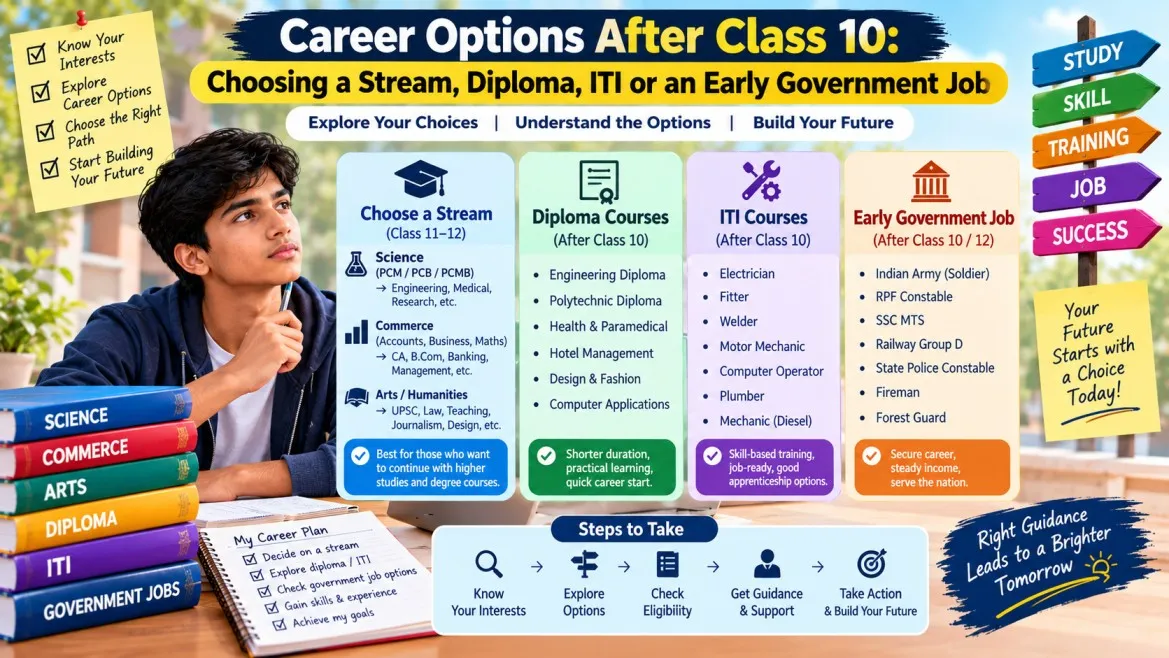
Option 1: Class 11–12 in a stream
Most students continue to Class 11 and 12. Schools offer subject combinations that are usually grouped into three streams. Check your board's scheme of studies for the exact combinations your school can offer — for CBSE schools, the official curriculum for 2026-27 lists every subject and valid combination.
Science
- Physics, Chemistry, Mathematics (PCM): leads to engineering, architecture, B.Sc. courses, data and computing careers, and defence entries that need Mathematics and Physics.
- Physics, Chemistry, Biology (PCB): leads to medicine and allied health courses (nursing, pharmacy, physiotherapy), biotechnology and life sciences.
Commerce
Accountancy, Business Studies and Economics, with or without Mathematics. It leads to B.Com, BBA, Chartered Accountancy, Company Secretary and Cost Accountancy courses, banking and finance roles.
Humanities (Arts)
History, Political Science, Geography, Economics, Psychology, Sociology and languages. It leads to law, journalism, teaching, social work, design, public policy — and it is a strong base for civil services preparation, whose papers draw heavily on these subjects.
Option 2: Polytechnic diploma
A diploma in engineering (for example Civil, Mechanical, Electrical or Computer Science) is a practical, skills-focused course. Diploma holders can work as junior technical staff, and many states and institutions allow them to join the second year of a B.Tech through lateral entry. In Bihar, admission to government polytechnics is through the entrance examination conducted by the Bihar Combined Entrance Competitive Examination Board (BCECEB) — check its website for the current year's notice.
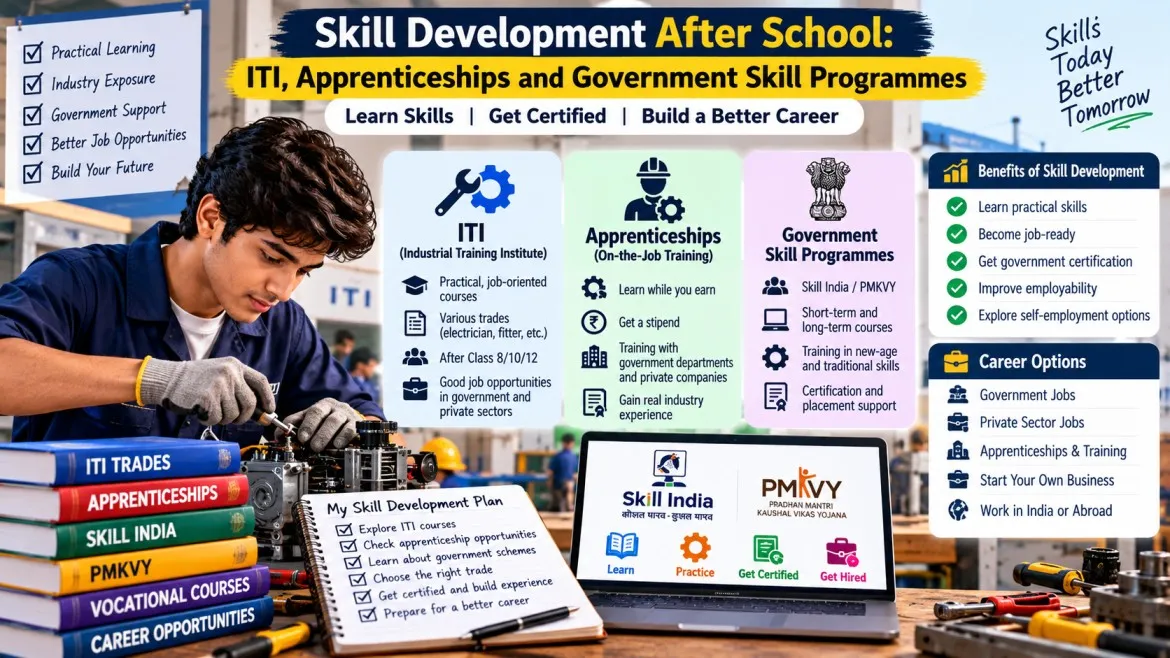
Option 3: ITI trade
Industrial Training Institutes (ITIs) teach trades such as Electrician, Fitter, Welder, Mechanic and Computer Operator. Courses are short and job-oriented, and the national framework is run by the Directorate General of Training (DGT). An ITI certificate, followed by an apprenticeship, is also a recognised qualification for several technical government posts, including posts in the railways.
Option 4: Government jobs open to 10th-pass candidates
Some central government recruitments accept Class 10 (Matriculation) as the minimum qualification. Examples from recent official notifications:
- SSC Multi-Tasking Staff (MTS) and Havaldar — Matriculation or equivalent.
- SSC Constable (GD) in central armed police forces — Matriculation or 10th class, plus physical standards.
- Railway Level-1 posts — qualifications are listed post-wise in the notification and include Class 10, an ITI certificate or a National Apprenticeship Certificate.
Every recruitment also has an age limit, and most require you to be 18. If you are not yet eligible, use the time to finish Class 12 or a diploma — it widens your options considerably.
How to decide
- Look at your strengths, not only your marks. Which subjects do you enjoy and do well in without being pushed?
- Think one step ahead. If you want to be a doctor, you need Biology in Class 11–12. If you want engineering, you need Mathematics. If you are unsure, Science with Mathematics keeps the most doors open, but only choose it if you can manage the workload.
- Consider money and time. A diploma or ITI gets you earning sooner; a degree route takes longer but leads to a wider range of jobs.
- Talk to people already on the path. A student two years ahead of you will tell you more about a course than any brochure.
Next steps
- List two or three options and write down the course duration, cost and the jobs each one leads to.
- Check the official admission notice (school, polytechnic or ITI) for dates and eligibility.
- Look for scholarships on the National Scholarship Portal if cost is a concern.
- Read our guides on career options after Class 12 and government job pathways by qualification.