Many government exam aspirants study for hours every day but still feel that nothing stays in their memory. The problem is often not effort but method. Rereading notes and highlighting textbooks feel productive, yet research suggests they are not the best ways to learn. This guide explains which techniques have research support and shows how to turn them into a realistic routine.
What the research says
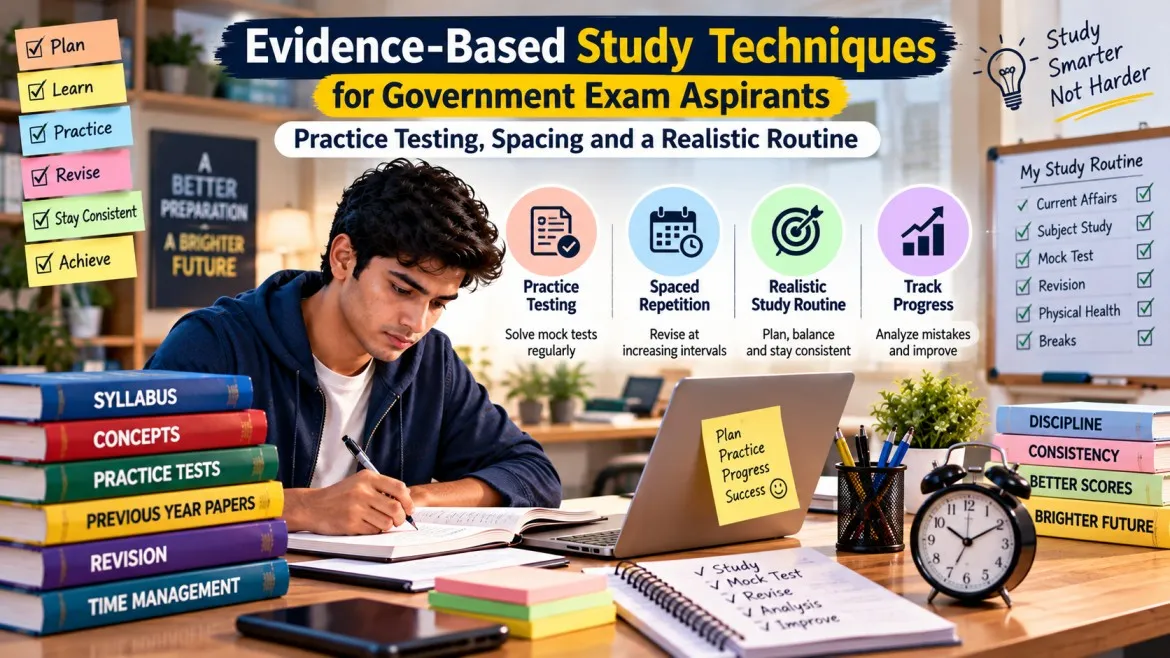
A well-known 2013 review by John Dunlosky and colleagues examined ten popular study techniques. Two came out on top: practice testing and distributed practice (spreading your study over time). The review found that rereading and highlighting, which many students use most, do not consistently improve performance, and it suggested using practice testing instead of rereading.
The authors also noted that these techniques are not magic. They help students who are motivated and willing to use them regularly.
Technique 1: Practice testing
Practice testing means trying to recall or answer questions from memory, instead of just reading the material again. This can be a flashcard, a question at the end of a chapter, a previous-year paper or a full mock test.
How to use it:
- After reading a topic, close the book and write down what you remember.
- Use flashcards for facts, dates and definitions.
- Solve previous-year questions topic by topic.
- Take full mock tests in exam conditions.
- Always check your answers afterwards and correct your mistakes. Feedback is what makes testing work.
Technique 2: Distributed practice (spacing)
Distributed practice means revising the same topic several times over days and weeks, instead of cramming it once. Spacing helps knowledge last longer.
Here is a simple schedule many students find practical. The research supports spreading study out, not these exact intervals, so adjust them to your own time:
| When | What to do |
|---|---|
| Day 1 | Learn the topic |
| Day 2-3 | First quick revision and a few questions |
| Day 7 | Second revision with practice questions |
| Day 14 | Third revision |
| Day 30 | Final revision before moving on to monthly review |
Mark the revision dates in a calendar or notebook so you do not have to remember them.
Technique 3: Mix your topics
Switching between related topics or question types during practice is called interleaving, and the review rated it moderately useful. For example, mix percentages, ratio and profit-loss questions in one practice set instead of doing only one type at a time. It feels harder, but it trains you to choose the right method, which is what the exam asks for.
Replace rereading with active recall
If you currently reread chapters again and again, try this instead:
- Read a section once with full attention.
- Close the book and summarise it from memory in your own words.
- Check your summary against the book.
- Note down what you missed and test yourself on it again later.
Build a realistic weekly routine
The following is a practical suggestion, not a research prescription. Change it to match your job, college or family duties.
| Time block | Activity |
|---|---|
| Morning | Study new topics (your hardest subject first) |
| Afternoon or evening | Practice questions on topics you studied earlier |
| Night | Short revision of the day's notes and a quick self-test |
| Once a week | One full-length mock test and a detailed review |
| Once a week | A lighter day for rest or catching up |
If you can only study 2-3 hours a day, keep the same structure but reduce the number of topics, rather than skipping practice and revision.
Keep a mistake notebook
Write down every question you get wrong, with the correct answer and the reason you made the error. Review this notebook every week. It becomes your personal list of weak areas, which is more useful than a general notebook.
Staying focused and avoiding burnout
- Study in focused blocks, for example 45-50 minutes, followed by a short break.
- Keep your phone out of reach during study blocks.
- Sleep regularly and take breaks. Constant study without rest tends to reduce your ability to focus.
- Do not compare your progress with other aspirants. Track your own mock test scores and accuracy over time.
Common mistakes
- Spending most of your time reading and almost none on testing.
- Starting a new book before revising the old one.
- Taking mock tests but not reviewing them.
- Studying without a revision schedule.
- Cramming the night before the exam.
What to do next
- Pick one subject you are studying this week.
- After each topic, close the book and write down what you remember.
- Put revision dates in your calendar for Day 3, 7, 14 and 30.
- Take one mock test this week and write down every mistake.
- Repeat each week and adjust your plan according to your scores.
Frequently asked questions
Is rereading completely useless?
No. A first read is needed to understand the material. The research suggests that rereading alone is less effective than testing yourself.
How many mock tests should I take?
This depends on your exam and time. Start with one a week, and review each carefully. Increase the number as your exam gets closer.
I have a job. Can I still prepare effectively?
Yes. Short, regular sessions with testing and spaced revision can work better than occasional long sessions.
Do I need special apps?
No. A notebook, flashcards and a calendar are enough.
Conclusion
You do not need more hours as much as better use of the hours you have. Test yourself, space your revision, review your mistakes and protect your rest. These small changes can make your preparation more effective in every government exam.