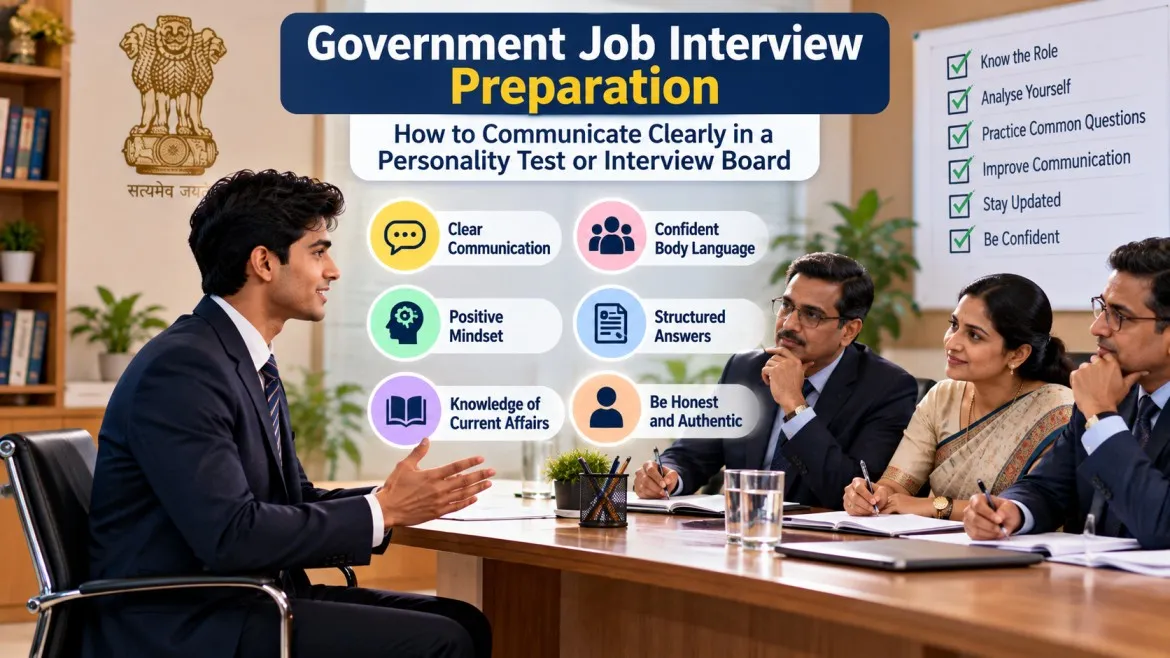
Many candidates spend months on written exams and then walk into the interview room with almost no preparation. A government interview or personality test is different from a written exam. The board is not mainly checking what you have memorised. It is trying to understand how you think, speak and behave. This guide explains what boards usually look for and how to prepare.
What an interview board is trying to assess
Take the UPSC Civil Services interview, called the Personality Test, as an example. Its stated purpose is to assess a candidate's personal suitability for a career in public service, through a board of competent and unbiased observers. UPSC describes the technique as a natural but purposeful conversation, not a strict cross-examination, and it says the interview is not meant to test specialised or general knowledge already tested in the written papers.
The qualities UPSC lists include mental alertness, clear and logical exposition, balance of judgement, variety and depth of interest, ability for social cohesion and leadership, and intellectual and moral integrity.
Other recruitment bodies, including state commissions such as BPSC, have their own interview rules, marks and formats. Always read the interview section of your own notification.
Step 1: Know your own profile thoroughly
The board often starts with what you have already submitted. Prepare to speak confidently about:
- your name, family background, native place and education,
- your subjects, projects and any work experience,
- your hobbies and interests, and anything you wrote on your application form,
- your reason for choosing this job and this service.
Whatever you wrote on a form can be asked about. Never include a hobby or achievement that you cannot explain.
Step 2: Learn a simple structure for answers
A clear structure helps you stay calm. Try this:
- Answer first. Give your main point in one sentence.
- Give a reason. Explain why in one or two sentences.
- Add an example. Use a short, real example if you have one.
- Stop. Do not keep talking after your point is made.
Short, organised answers show clarity. Long answers that wander make it difficult for the board to follow you.
Step 3: Prepare for opinion and situational questions
Boards often ask what you would do in a situation or what you think about a public issue. For these:
- listen to the whole question before answering,
- consider more than one side of the issue,
- give a balanced view and explain your reasoning,
- avoid extreme or emotional statements,
- stay honest and consistent with your earlier answers.
For a situational question, state the facts you need, say what you would do first and why, and mention the rules or people you would involve.
Step 4: Be honest about what you do not know
If you do not know an answer, say so politely and, if appropriate, say what you do know about the topic. Guessing wildly or making up facts usually creates a worse impression than a calm "I am sorry, I am not sure about this."
Step 5: Stay informed about your state and country
Even if the board does not test knowledge as such, it may expect you to know about major current events and your own region. For a Bihar candidate, that can mean understanding your district, state schemes and local issues, and being able to discuss them in an informed, balanced way. Read a reliable newspaper regularly and note down key developments.
Step 6: Choose your language and practise it
Some recruitment boards allow the interview in Hindi or another language, if the notification permits. Choose the language in which you can think and speak most clearly, and practise in that language. Clear speech in your own language is better than hesitant speech in a language you are less sure about.
Step 7: Practise with mock interviews
- Ask a teacher, senior or friend to act as a board and ask unexpected questions.
- Record yourself and listen for filler words, fast speech and long pauses.
- Ask for feedback on your answers, posture and eye contact.
- Practise sitting, walking in, greeting and leaving.
Body language and presentation
- Dress simply and neatly.
- Greet the board politely and wait to be asked to sit.
- Sit upright, keep your hands still and look at the person who is speaking.
- Speak at a steady pace and a clear volume.
- Stay calm if a question surprises you. A short pause before answering is fine.
Interview-day checklist
- Admit or call letter and photo ID.
- All original documents and photocopies listed in the notification.
- Reach the venue early, after checking the route the day before.
- Keep your phone off.
- Sleep well the night before.
Common mistakes
- Memorising answers word for word.
- Arguing with the board or trying to win the discussion.
- Giving very long answers.
- Exaggerating or lying about your background.
- Ignoring the notification's instructions on documents and reporting time.
What to do next
- Read the interview section of your notification.
- Write down 20 questions about yourself and answer each in under a minute.
- Do two mock interviews before the date.
- Read a newspaper daily and make short notes.
- Prepare your documents in a folder a week early.
Frequently asked questions
How much does the interview matter?
It depends on the recruitment. Some give interview marks that count in the final merit, while others use it differently. Check your notification.
Can I take the interview in Hindi?
Some boards allow it. Check whether your recruitment does.
What if I make a mistake in an answer?
Correct yourself politely and move on. Calm recovery is better than panic.
Do I need to know everything about current affairs?
No one knows everything. Be well informed on major issues and on topics linked to your background and the job.
Conclusion
A government interview is a conversation about your suitability for public service. Know your own profile, answer clearly and honestly, practise in the language you are most comfortable with, and stay calm. Good preparation will let your personality come through.